Booking your first kitesurfing course is exciting – and a little nerve-racking if you do not know what is coming. Knowing what to expect from kite lessons helps you relax, learn faster and get far more out of every hour on the beach. Here is how a typical beginner course runs, what you should bring and how to recognise a good kite school Egypt riders can trust.
Before you start: what a good kite school looks like
The quality of your teaching shapes everything that follows. When you compare schools, look for:
- Experienced instructors who teach in small groups or one to one, and who adapt to your pace.
- A safe teaching spot – shallow, flat water, a sandy bottom, steady cross-onshore wind and plenty of space.
- Well-maintained, modern equipment in a range of sizes for different wind strengths.
- Safety first: a proper safety briefing, helmets, impact or buoyancy aids, beach assistance and a rescue plan.
- Clear progression: you should know which skills each lesson covers and what comes next.
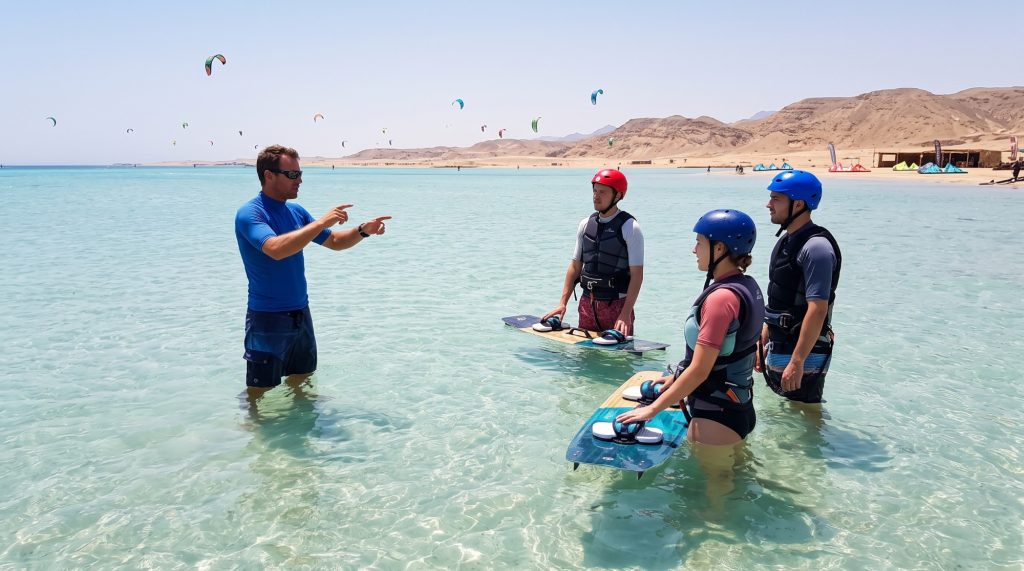
Our kite lessons Hurghada take place on a waist-deep lagoon between Hurghada and El Gouna, with radio helmets available on request so your instructor can coach you even when you are riding away from them. For more tips, see how to choose a kite school in Hurghada.
Day 1: wind theory, safety and your first kite
The first session usually starts on the sand. Your instructor explains the wind window – the area where the kite flies – and shows you where it pulls gently and where it generates real power. You will learn to judge wind direction and strength, how the bar and lines work, and how to use the safety systems to depower or release the kite.
Then you will fly a small two-line trainer kite. It feels simple, but it builds the muscle memory you will rely on later. After that you move on to a four-line inflatable (LEI) kite with your instructor holding on to you, learning to steer smoothly and keep the kite stable at the edge of the window.
Day 2: into the water – body dragging
Day two is about getting comfortable in the water with the kite. In a body drag you let the kite pull you through the water without a board. You will practise dragging downwind and then upwind, which is how you recover your board if you lose it. You will also learn to relaunch the kite when it lands on the water – an essential skill for riding independently.
Day 3: the board and your first water start
Now the board comes in. Lying in the water with your feet in the straps, you dive the kite through the power zone, let it pull you up and try to stand. The first attempts usually end with the board shooting away or with you nose-diving – that is all part of the process. In shallow water you simply stand up and try again. By the end of the day many students manage their first short rides.
Day 4: riding, stopping and staying upwind
With a few rides behind you, the focus shifts to control: riding in both directions, slowing down and stopping in a controlled way, and starting to hold your ground upwind. This is also when you learn to launch and land the kite with an assistant – the last big step towards kitesurfing on your own.
What to expect from kite lessons: how long does a full course take?
Most people need around 10 to 12 hours of tuition, spread over three or four days, to reach independent riding. At our school the pathway runs from a 3-hour Introduction through Level 1 (6 hours), Level 2 (9 hours) and Level 3 (12 hours). You can book the whole programme or take single one-hour lessons to fill gaps.
Group or private kite lessons?
Private lessons give you the instructor’s full attention, which usually means faster progress and more time with the kite in your hands. Shared lessons can be more sociable and cost less per person, but you will spend part of each session watching. If your holiday is short, private tuition is often the better investment.
What to bring to your kite lessons
- Swimwear and a lycra or rash vest; in winter, a long 5 mm wetsuit.
- High-factor, water-resistant sun cream and sunglasses with a strap.
- A water bottle and a snack – kitesurfing is hungry work.
- A positive attitude: you will fall, and that is fine.
The school provides the kite, bar, board, harness, helmet and – at Sultan Kite School – wetsuit boots and insurance for the training period.
How to get the most from every lesson
- Listen first, then try. Small details in kite position make a huge difference.
- Ask questions. Good instructors love curious students.
- Rest when you need to. Tired muscles make for sloppy kite control.
- Check the wind. Our live Hurghada wind forecast shows the current conditions at the lagoon.
Now that you know what to expect from kite lessons, you can relax and focus on enjoying every session.
After the course
Once you can ride both ways and stay upwind, the best thing you can do is keep practising. After Level 3 our students can hire equipment at discounted student rates, and our kite rental in Hurghada covers everything from kites and boards to harnesses and wetsuits. Ready to book? Contact us and we will help you choose the right course.
For an overview of international teaching standards, visit the International Kiteboarding Organization.