If you have started looking into the sport, you will have seen two names used almost interchangeably: kiteboarding and kitesurfing. Are they the same thing? Mostly, yes – but the words carry slightly different shades of meaning, and the sport itself has several distinct styles. Here is a clear explanation of kiteboarding vs kitesurfing, and the disciplines you can try.
Kiteboarding vs kitesurfing: the short answer
Both terms describe riding a board on water while being pulled by a large, controllable kite. In everyday use they mean the same sport. Kitesurfing is the more common term in Europe, including the UK, and it is often used when people think of riding waves or surfboards. Kiteboarding is widely used in North America and tends to be associated with twin-tip boards, tricks and jumps. You will hear both on any kite beach in Egypt, and nobody will mind which one you use.
How it works
The rider stands on a board and wears a harness that connects to a control bar. The kite is attached to the bar by lines, usually four. By steering the kite through the wind window – the area of sky where it can fly – the rider generates power to move across the water. Pulling the bar in increases power; pushing it out reduces it. A quick-release safety system lets the rider depower or detach the kite instantly.
The main riding styles
Freeride
Freeride is what most people do most of the time: cruising, carving, jumping and simply enjoying the ride. It is the natural first step after your kiteboarding lessons and suits flat water perfectly.
Freestyle
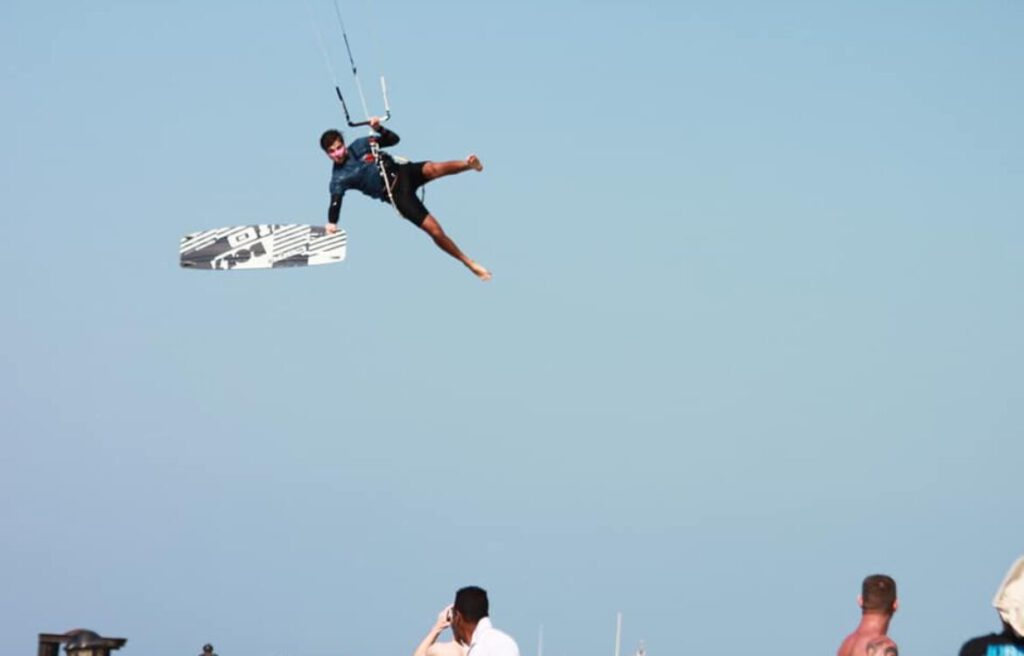
Freestyle focuses on tricks – spins, rotations and unhooked manoeuvres where the rider detaches from the harness. It is easiest to learn on flat, shallow water with steady wind, which is why lagoons like ours in Hurghada are so popular with freestylers.
Big air
Big air riders use specialised kites and strong wind to launch huge jumps with long hang times. It is spectacular to watch and demands advanced skills and excellent kite control.
Wave riding
Wave riding – the purest form of kitesurfing – uses a directional surfboard, often without footstraps, to ride and carve waves, with the kite providing power to get back out.
Foiling
A hydrofoil lifts the board above the water on a wing, cutting drag dramatically. Foilers can ride in very light wind and glide silently across the surface. It has its own learning curve, so it is best tackled once you can ride a twin-tip confidently.
Which style should beginners start with?
Almost everyone starts with freeride on a twin-tip board in flat or slightly choppy water. It is the quickest way to master kite control, water starts, riding upwind and transitions – the foundations of every other style. Once you have those skills, you can branch out into freestyle, waves or foiling.
Where to try it
Egypt’s Red Sea coast is one of the best places in the world to learn, whatever you call the sport. Our lagoon between Hurghada and El Gouna offers waist-deep water, a sandy bottom and steady cross-onshore wind. Take a look at our kiteboarding lessons Hurghada, hire gear from our rental centre – including hydrofoils for experienced riders – or get in touch for advice.
For background on the sport and its governing bodies, see the British Kitesports Association.