Every good kitesurfing session starts with a quick look at the wind. But forecasts can be confusing: knots or km/h, average wind or gusts, arrows pointing which way? Learning how to read a wind forecast for kitesurfing helps you choose the right spot and kite size – and, just as importantly, tells you when to stay on the beach. Here is a simple guide, using our lagoon in Hurghada as an example.
1. Wind speed: knots and km/h
Kitesurfers usually talk in knots. One knot is about 1.85 km/h, so 15 knots is roughly 28 km/h. As a rough guide for an average adult rider:
- Under 10 knots: generally too light for most twin-tip riding (foilers may still have fun).
- 12–20 knots: the sweet spot for learning and freeride.
- 20–25 knots: powered-up conditions for confident riders on smaller kites.
- Over 25–30 knots: strong wind for experienced riders only.
2. Average wind vs gusts
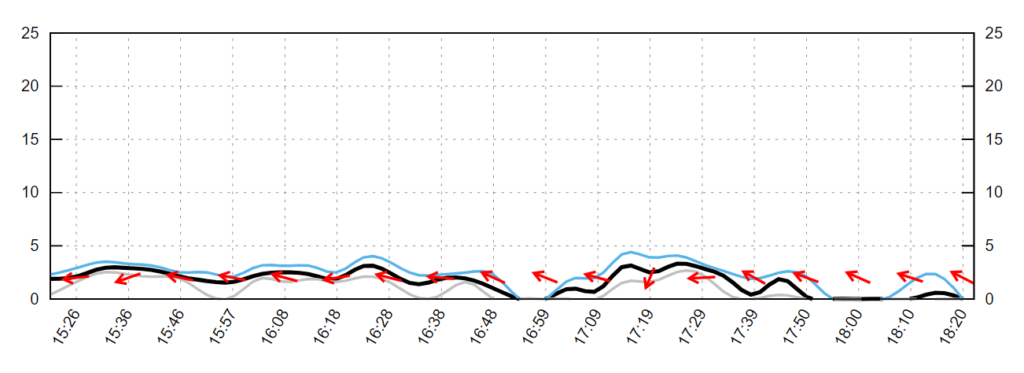
Most forecasts show two numbers: the average wind and the gusts. The gap between them tells you how steady the wind is. A forecast of 16 knots gusting 19 is smooth and comfortable; 16 knots gusting 28 is gusty and much harder to manage. Always size your kite for the gusts as well as the average – being overpowered in a gust is when accidents happen.
3. Wind direction
Direction is shown as compass points (N, NE, NW…) or degrees, and on many charts as arrows. Note that forecasts show where the wind is coming from: a “north” or 0° wind blows from the north towards the south. What matters for kitesurfing is the direction relative to the shore:
- Cross-shore / cross-onshore: ideal and safe.
- Onshore: safe from drifting out, but tricky for launching.
- Offshore: dangerous without a rescue boat – avoid it.
At our lagoon the wind blows mainly from the north, cross-onshore, and sometimes from the east. In May and November it can turn south-south-east.
4. Live data vs forecast
A forecast predicts what the wind will do over the coming hours and days. A weather station measures what it is doing right now. Use both: the forecast to plan your week, live data to decide when to head to the beach. Our live Hurghada wind forecast shows the current average wind, gusts and direction from the station close to our spot, updated every 10 minutes, with a chart of the last three hours and a history of previous days – plus a multi-day forecast from Windy.app.
5. Read the wind forecast for kitesurfing as a trend
Look at how the wind changes through the day. Is it building towards the afternoon or dropping? Are the gusts getting bigger? A steady or rising trend is a good sign; a sudden jump in gusts or a big change in direction can mean unstable conditions.
6. Choose your kite size
Once you know the wind, choosing a kite is much easier. As a very rough guide for an average adult on a twin-tip: 12–14 m² in light wind, 9–11 m² in medium wind and 6–8 m² in strong wind. Your weight, board size and skill all play a part – ask the team at our kite rental centre if you are unsure, and when in doubt, go smaller.
7. Use your eyes too
- Watch the water: whitecaps usually mean 12–15 knots or more.
- Look at flags and windsocks on the beach.
- See what size kites other riders are using.
- Ask the local school – they know how the spot behaves.
The more often you compare the wind forecast for kitesurfing with what you see on the water, the better your judgement becomes.
Quick go / no-go checklist
- Is the wind within my range, including gusts?
- Is the direction cross-shore or cross-onshore?
- Is the trend stable or improving?
- Do I have the right kite size?
- Is there help on the beach if I need it?
If the answer to any of these is no, wait it out. There is always another session. For more on staying safe, read our kitesurfing safety tips.
For a deeper explanation of wind strength, see the Met Office guide to the Beaufort scale, and compare multi-day models on Windy.app.