The spot you choose has more influence on your session than almost anything else. The same kite and the same rider can have a brilliant day in one place and a stressful one a few kilometres away. Knowing how to choose a kite spot keeps you safe, helps you progress and makes kitesurfing far more enjoyable. Here is what to look for – and if you are learning, read how to choose a kite school in Hurghada too.
When you are deciding how to choose a kite spot, work through these seven points in order.
1. Wind direction
Wind direction relative to the shore is the first thing to check.
- Cross-shore or cross-onshore – the best and safest directions. The wind blows along the beach or slightly towards it, so if anything goes wrong you drift back to land.
- Onshore – blows straight onto the beach. Safe from being carried out to sea, but launching is tricky and it is easy to be pushed into the shore.
- Offshore – blows away from the land. Never ride in offshore wind without a rescue boat; the wind is also gusty and unreliable close to shore.
In Hurghada the prevailing wind comes from the north and blows cross-onshore along much of the coast – one reason it is such a good place for Red Sea kitesurfing.
2. Wind strength and consistency
Steady wind is much easier to ride than gusty wind. Look for spots where the breeze comes in across open water rather than over hills or buildings, which create turbulence. As a general guide, beginners are most comfortable in roughly 12–20 knots, while experienced riders can handle much more. Always check a reliable forecast – such as our live Hurghada wind forecast – before heading out.
3. Water depth and seabed
For learning, shallow water is a game changer. When you can stand up after every fall, you spend your time practising instead of swimming. A sandy bottom with no rocks, sharp shells or coral protects your feet and your board. Waist-deep lagoons, like the one at our kite school in Hurghada, are about as good as it gets.
4. Flat water or waves?
Flat water is ideal for beginners, freestyle and speed. Choppy water builds skills but is tiring, and waves are for experienced riders who want to surf. Lagoons protected by sandbanks or reefs usually offer the flattest water.
5. Space and hazards
You need a wide launching area on the beach and plenty of room downwind on the water. Look out for:
- Trees, buildings, power lines and roads near the launch area.
- Piers, jetties, moored boats and swimming zones on the water.
- Crowded spots where lines can tangle.
- Strong currents and tides that change the water depth.
6. Rules and local knowledge
Many beaches have kite zones, launching areas and right-of-way rules. Ask the local school or rescue service about the spot before your first session – they know where the hazards are, how the tide behaves and which wind directions work best.
7. Facilities and safety cover
A good kite centre makes life easier and safer: beach assistance for launching and landing, rescue cover, storage, a compressor, fresh water to rinse your gear and somewhere shady to rest. Our centre offers all of these, plus kite storage and equipment rental right on the lagoon.
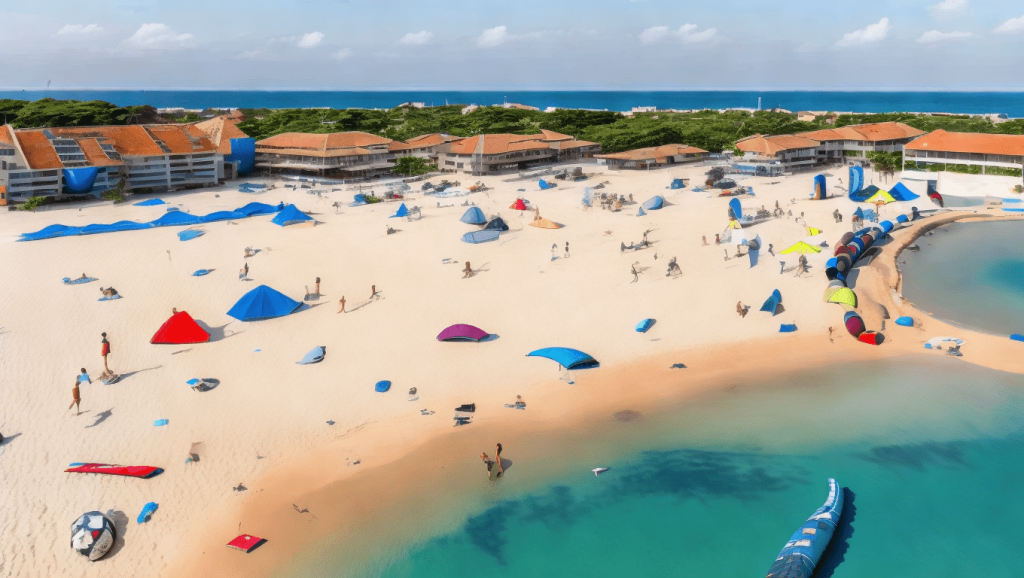
How to choose a kite spot: quick checklist
- Is the wind cross-shore or cross-onshore?
- Is it steady and within my range?
- Is the water depth right for my level, with a safe seabed?
- Is there enough space on the beach and downwind?
- Do I know the local rules and hazards?
- Is there help nearby if I need it?
If you can answer yes to every question, you have found a great place to ride. And if you want to skip the guesswork, come and ride our lagoon between Hurghada and El Gouna – get in touch to plan your visit.
The Met Office guide to the Beaufort wind scale is a handy reference for judging wind strength.